

Dealing with students who do not meet the requirements for a sufficient grade
Within the Master’s programmes of the Graduate School of Life Sciences, examiners are responsible for ensuring that students only receive a passing grade when all learning objectives and assessment criteria have demonstrably been met. If a student does not meet the requirements for a sufficient grade, a pass cannot be awarded. This is essential because:
- students might otherwise graduate without being adequately prepared for the next step;
- it would be unfair to students who have met the required standards;
- it may lead to devaluation of the Master’s degree of the GSLS.
How to prevent or deal with these situations?
At the start of the project, internship, or writing assignment
At the start discuss the rubrics. In this way, it is clear to the student what is expected. For internships indicate what you think is important for the first 2-3 months. Also make a planning with clear deadlines, which can be adapted when you feel it is appropriate. In general, it is good to maintain a ‘dossier’ (this can be the email exchange and certain agreements/assessments) in case at the end there is a dispute or even an appeal to the Examination Appeals Board.
Interim Assessment
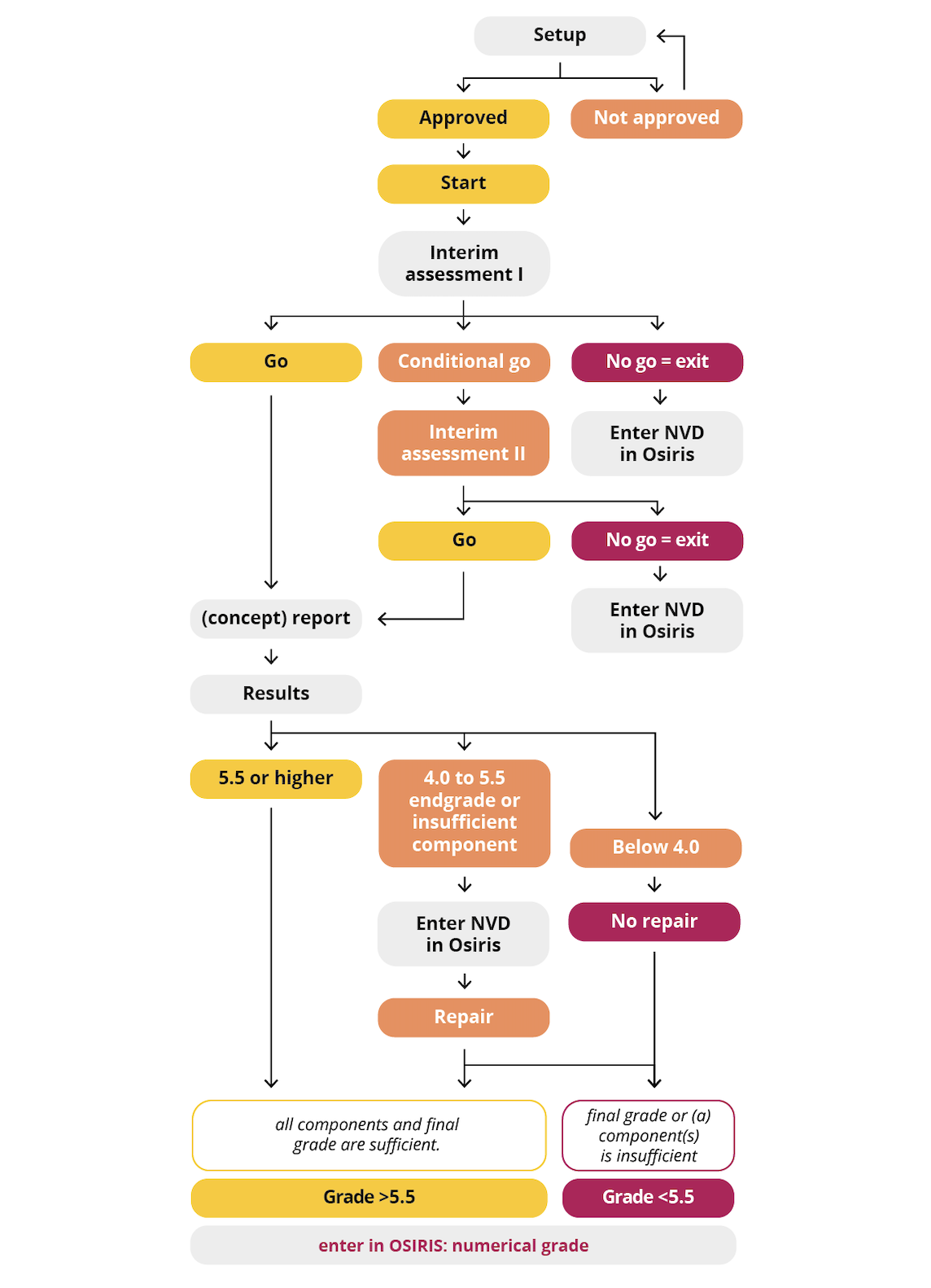
The Interim Assessment is part of the regular assessment procedure for research projects and business internships at the GSLS. It is a “go/conditional go/no go” moment and should prevent that a student continues with the study component when it is unlikely that it will lead to a successful end. For uncertain situations a conditional go can be decided on; make very clear what should change within what time frame, put it in writing and re-evaluate at said time. It is important the Interim Assessment is done timely (2-3 months after the start) and that it is documented and handed in.
At the end of the project
The end of the project, internship, or writing assignment will normally be (around) the end date mentioned in the application form. The component should be graded, unless exceptional conditions led to a new, postponed end date. For research projects and business internships there are three subgrades and each of them should be sufficient. For the writing assignment there is one grade. There can be two situations: there is an end product, or there is no end product.
NB. If there were circumstances beyond the control of the student leading to an insufficient grade or NVD, the student can contact the study advisor and/or Board of Examiners to request a provision for testing in special cases (EER art 5.8).
End product present
The product will be graded and all grades – sufficient or insufficient – are documented in Osiris, together with the other required information.
- All subgrades are sufficient. Great, you are done.
- If the final grade is insufficient and below 4.0, the student does not get a repair opportunity and fails the study component.
- If the final grade is insufficient but 4.0 or higher, or when the subgrade(s) is/are insufficient, and the student has fulfilled all the obligations to perform to the best of their ability (inspanningsverplichting), the student is once entitled to a repair (EER art. 5.5). Make clear agreements regarding what should be done and when and put this in writing. When the student hands in the repair assignment, it should be assessed again and all grades after the repair are documented in Osiris. If the repair assignment of the student results in another insufficient grade, the student does not get an extra repair assignment and has failed the study component. Of course this can be saddening, frustrating, and even difficult but should not prevent you from giving an insufficient grade when the work does not meet the requirements.
No end product present
- If a final date has been clearly set: grade the missing component with NVD and the final grade also with NVD and document all grades in Osiris. If you, as an examiner, feel that the original end date should be postponed, you can do that, but make clear agreements. When the end date is postponed more than 20 working days, the student should contact the research project coordinator. When after the new deadline the product is still missing you need to grade the component and the final grade with an NVD and document all grades in Osiris, together with the other required information.
- When no final date has been set to hand in the product: set a date in writing. If at the new final date the end product is handed in, go to the steps under End product present.
- If at the new final date no end product is handed in: grade the component and the final grade with an NVD and document all grades in Osiris, together with the other required information.
Grading flowchart
In order to help you as an examiner with the grading of a research project or writing assignment, the Assessment Support Panel developed the following flowchart:
Examiners can always seek advice from the Board of Examiners, Assessment Support Panel, or programme coordinator.